
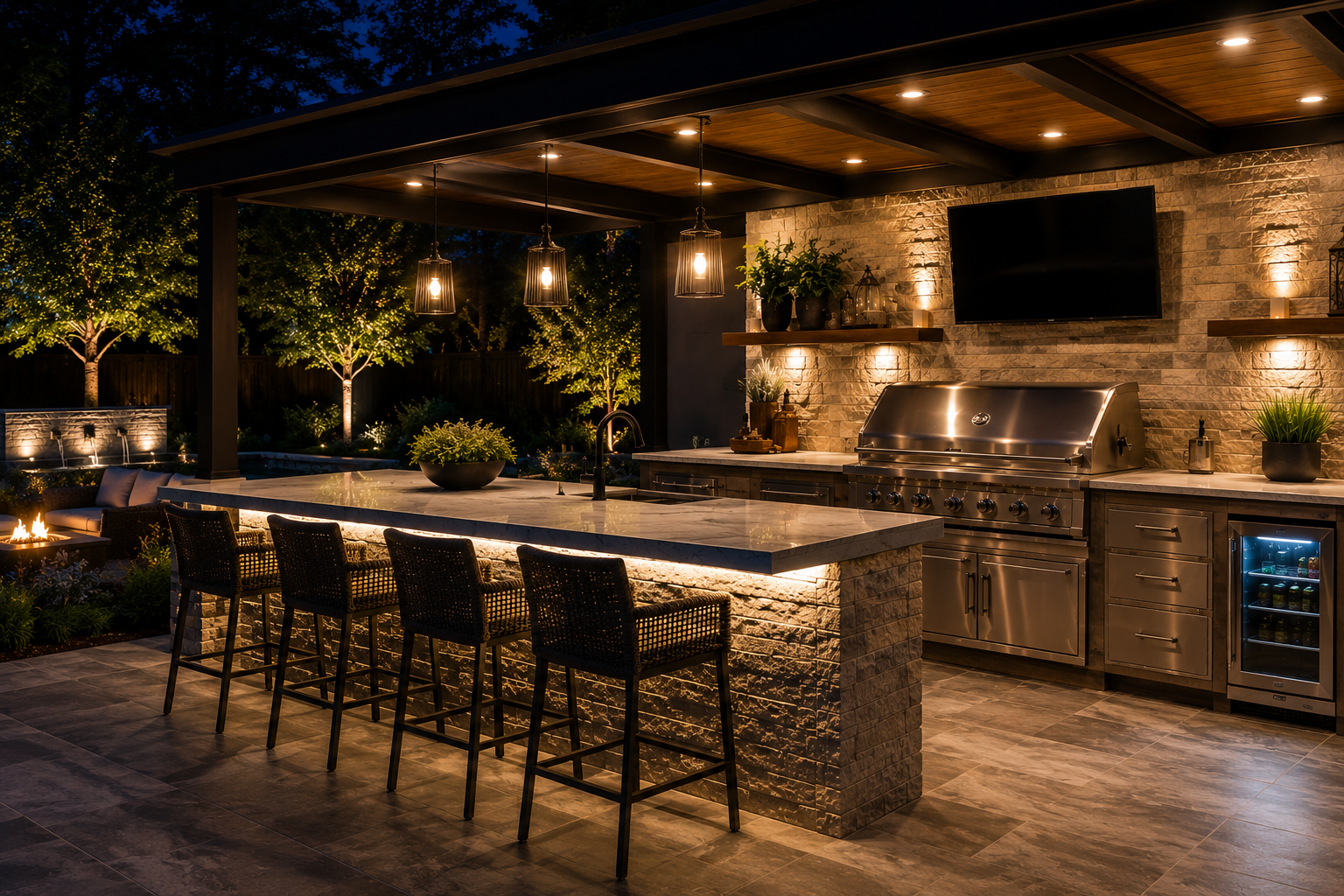
Outdoor kitchen lighting guide
How to Light Up an Outdoor Kitchen
Plan task, ambient and accent lighting so your BBQ area is safe to cook in, comfortable to sit in, and still atmospheric after dark.
A well-lit outdoor kitchen makes it easier to see the grill, knives, skewers, hot pans and prep surfaces. The goal is not one harsh floodlight. You want layers: bright light where you cook, a warm glow where people sit, and accents that make the garden feel finished.
On this page
Quick plan
The simple lighting recipe
Start with the cooking zone, then soften the seating area, then add low-level accents. Each layer should switch separately so the space can move from cooking mode to evening mode.
Light the grill and prep
Use focused downlights, wall spots or under-shelf LEDs so you can check colour, doneness and flare-ups clearly.
Warm the dining area
Use wall lights, festoons or canopy downlights around 2700-3000K so guests are comfortable without glare.
Add depth around the edges
Uplight planting, screens or textured walls to make the kitchen feel like part of the garden, not a bright island.
Lighting layers
Task, ambient and accent lighting
Outdoor kitchen lighting works best when each layer has a job. That keeps the cooking area safe without making the whole patio feel clinical.
Task lighting
Bright, focused light aimed at the grill, hob, sink and prep surfaces. This is the safety layer.
- Adjustable wall spots
- Under-pergola downlights
- Under-shelf or under-counter LED strips
Ambient lighting
The comfortable general glow that lets people move, eat and talk without harsh hotspots.
- Exterior wall lights
- Warm canopy downlights
- Festoon or string lights
Accent lighting
The depth layer that highlights planting, pergolas, screens, cladding and architectural details.
- Spike uplights
- Low wall grazers
- Subtle LED strips on beams
UK weather
Choose fittings with the right IP rating
Outdoor kitchens see rain, condensation, steam, grease and occasional hose spray. Use exterior-rated fittings and get permanent mains work installed properly.
| Location | Typical minimum | Use it for | Design note |
|---|---|---|---|
| Sheltered canopy or porch | IP44+ | Protected wall lights and downlights | Still keep fittings away from direct grill heat and grease. |
| Exposed patio or garden wall | IP55-IP65 | Wall lights, spots, spike lights and path lights | Better for direct rain and normal garden weather. |
| Near water features or possible submersion | IP67-IP68 | Specialist water-adjacent fittings | Use products designed for that exact location. |
Example scheme
A small UK patio lighting setup
For a compact outdoor kitchen, this is enough to make the space practical without over-lighting it.
Cooking
Two adjustable downlights aimed at the grill and main prep zone, plus a short LED strip under a shelf.
Dining
A pair of warm wall lights on the house or boundary, dimmed lower once food is served.
Garden
Two small uplights behind the kitchen to graze planting or a slatted screen.
Power options
Mains, low-voltage, solar and battery
Mains
Best for core task and ambient lighting where reliability, dimming and switching matter.
Low-voltage LED
Useful for strips, shelves, counters and some garden lighting systems.
Solar
Good for seasonal mood lighting, but do not rely on it for safety-critical grill lighting.
Battery
Handy for table lamps and flexible seating, especially when you want no cables.
Safety and comfort
Avoid glare, heat damage and bad wiring
Aim lights at surfaces
Spots should illuminate the worktop and grill, not the cook’s eyes or guests across the table.
Keep away from heat and grease
Do not mount fittings directly above open flames or where they will be constantly splattered.
Use proper outdoor electrics
Permanent outdoor wiring should use protected cable routes, sealed joints, suitable fittings and RCD protection.
FAQs
Outdoor kitchen lighting questions
What colour temperature is best outside?
Warm white around 2700-3000K usually feels best for seating and dining. Task lighting can be a little brighter and cleaner, but avoid making the whole garden feel stark.
Can I use solar lights for an outdoor kitchen?
Solar lights are useful for mood and seasonal accents, but mains or properly designed low-voltage lighting is better for grill, prep and safety-critical zones.
Do outdoor kitchen lights need an electrician?
Permanent mains-powered outdoor lighting should be installed by a qualified electrician using suitable exterior fittings, cable routes and circuit protection.