
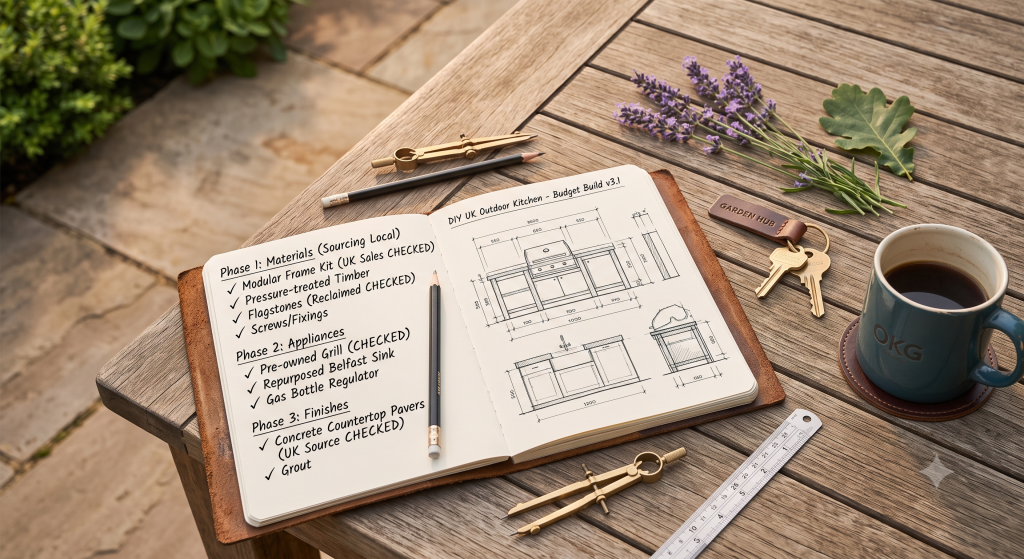
DIY outdoor kitchen build budget
DIY Outdoor Kitchen Budget
Work through the build in the right order and build a realistic budget for ground prep, framing, units, cooking kit, shelter, lighting, electrics, plumbing and the hidden extras.
A DIY outdoor kitchen budget should be built like the project itself: base first, structure second, services before finishes, then cooking equipment and the nice-to-have extras. The common mistake is pricing the grill and cabinets but leaving out the ground, waste, fixings, delivery, tool hire and qualified trades.
Price check note: Cost examples on this page were reviewed on 8 June 2026 from UK merchant pages including B&Q, Screwfix and Toolstation. I have only kept merchant examples where the page showed a product rating and an availability signal such as add to basket, delivery, click and collect, local stock or stock-check options. Prices, ratings and stock change by postcode and offer period, so treat them as budgeting examples rather than a final quote.
Quick answer
How much should you budget for a DIY outdoor kitchen?
For a UK garden, a realistic DIY outdoor kitchen can start at about £300 if you only mean a usable outdoor cooking corner: a basic freestanding BBQ, a small weatherproof storage box and a cover or prep surface. A fixed kitchen with framing, cladding, worktop, services and trade checks starts much higher.
Basic cooking corner
£300-£1,500
Best for a freestanding BBQ, small storage box, cover and a simple prep surface on an existing patio. This is not a built kitchen, but it can be a sensible first step.
Starter built setup
£1,500-£3,500
Best for a small modular or simple framed run on an existing sound patio, using a freestanding BBQ, basic storage and little or no new services.
Typical DIY build
£3,500-£7,500
Best for a framed or blockwork kitchen with a proper worktop, weather-resistant cladding, a midrange BBQ, lighting and some trade help.
Larger or serviced
£7,500-£15,000+
Best for a new slab, pergola, built-in appliances, sink, outdoor power, fixed gas, drainage, premium surfaces or a more permanent landscaped build.
Step 1
Define the build before pricing materials
Start with a one-page brief. Write down the finished size, where the kitchen will sit, what you want to cook on, whether it needs shelter, and which services are essential. This stops the budget becoming a shopping list of attractive parts that do not fit together.
Size the runMeasure the length, depth and finished height. A 2.4m run is a very different budget from a 4m L-shape.
Choose the build routeModular units, timber frame, blockwork and metal cabinets all have different costs, tools and weather risks.
Mark the servicesDecide early whether you need power, lighting, water, waste, gas, or none of them.
Separate DIY and trade workKeep qualified electrical, fixed gas and drainage work as separate budget lines, not as a vague contingency.
Step 2
Price the build stage by stage
Use the table as a budgeting worksheet. Add quantities for your own design, then add delivery, waste and a contingency line at the end. The merchant examples are there to sanity-check the bands, not to force a single shopping list.
| Build stage | What to include | Realistic DIY budget range | Budget note |
|---|---|---|---|
| Basic cooking corner | Freestanding BBQ, cover, compact outdoor storage box, simple prep table or trolley. | About £300-£1,500. A rated B&Q 4-burner BBQ around £200 plus a rated Keter storage box around £25-£45 shows why a basic setup can start low. | This is the cheapest useful route, but it is more of an outdoor cooking station than a built kitchen. |
| Ground prep and base | MOT Type 1 sub-base, sand/cement, concrete, paving or slab materials, compactor hire, skip bags. | Often £250-£1,200 for a small correction or pad, and much more if the existing patio is weak. Bulk aggregates and delivery can swing the price quickly. | Do not price the kitchen until you know whether the existing patio is strong enough. |
| Blockwork or masonry base | Dense blocks, mortar, ties, DPC, render beads, vents, access openings and stainless doors. | Concrete blocks around £2.40-£2.70 each were visible from rated B&Q examples, before mortar, DPC, vents, doors or delivery. | Heavy masonry may need a better foundation than light modular units. |
| Timber frame | Pressure-treated timber, posts, noggins, screws, angle brackets, treatment for cut ends. | Allow roughly £150-£600+ for a small framed carcass before boards, cladding and worktop. Merchant timber quality varies, so inspect for twisting and splits. | Use timber carefully near heat and moisture; keep it ventilated, protected and away from hot BBQ zones. |
| Sheathing and cladding | Cement board, tile backer board, exterior cladding, tiles, render, adhesive, trims and fixings. | Rated B&Q backer-board examples were around £11-£15 per board, but a full finish can run from hundreds to several thousand pounds once adhesive, trims and cladding are included. | A cheap carcass becomes expensive if the finish is not weather-suitable. |
| Units and storage | Outdoor storage boxes, cabinets, doors, drawer units, shelves and stainless access doors. | Simple rated storage boxes were visible around £25-£160. Purpose-made outdoor cabinetry is usually much higher than indoor kitchen units. | Indoor chipboard units are not outdoor-rated; only use them in very protected designs. |
| Cooking equipment | Gas BBQ, charcoal grill, plancha, pizza oven, side burner, cover, regulator and gas bottle. | Rated practical examples ranged from about £200 for a B&Q 4-burner gas BBQ to about £130 for a rated tabletop pizza oven. Premium BBQs and built-ins push this line much higher. | This is the easiest line to overspend on. Protect prep space before adding a second cooker. |
| Pergola or shelter | Posts, beams, rafters, fixings, post bases, roof covering, shade sail, awning or kit pergola. | Allow hundreds for a modest DIY shade solution and £1,500+ for many complete pergola-kit style builds before foundations and lighting. | Check height, boundary position, wind loading and footing costs before buying a kit. |
| Lighting | Outdoor wall lights, task lights, festoon lights, PIR lights, switches, cable and transformers. | Rated outdoor wall lights were visible around £10-£36 each before bulbs, cable, switching and electrician labour. | Budget separately for the electrician; fittings are only part of the lighting cost. |
| Electrics | Outdoor sockets, SWA cable, RCD protection, consumer unit work, certification and electrician labour. | Rated IP66 outdoor sockets were visible around £10-£24, but a proper outdoor circuit can cost hundreds once cable route, protection and labour are included. | Outdoor circuits are not a casual DIY job. Allow a qualified electrician line. |
| Plumbing and waste | Outdoor tap, isolating valve, sink, trap, 40mm waste pipe, gully or drainage route. | Rated Toolstation examples showed outdoor taps around £8.49 and 40mm waste pipe around £6-£7 per 3m length, before sink, trap, valves, labour and drainage work. | Water is optional. Waste is the awkward bit, especially if there is no legal drain nearby. |
| Tools, delivery and waste | Compactor, mixer, masonry saw, grinder blades, PPE, sealants, skips, delivery charges and spare materials. | Often 10-20% of the materials budget once deliveries and consumables are included. | Small missed items can easily add hundreds of pounds. |
Step 3
Decide which services are worth paying for
Services are where DIY budgets become serious. A no-services kitchen can be assembled like a robust garden workstation. Add power, gas, water and waste, and the project starts to behave more like a small building job.
Power and lighting
Budget for cable route, RCD protection, outdoor-rated accessories, light fittings, switching and certification. The socket price is small compared with a proper outdoor circuit.
Water and sink
A cold feed can be useful, but it needs isolation for winter and a sensible drain route. A bucket under the sink is not a long-term waste plan.
Gas
Bottled gas keeps the budget flexible. Fixed gas pipework should be planned and connected by a qualified Gas Safe engineer.
Step 4
Add contingency before you fall in love with finishes
Add 10% for a straightforward modular build, 15% for a framed or masonry build, and 20% or more where the ground, drainage, pergola footings or services are uncertain. If the contingency feels too high, simplify the design before you start rather than hoping the awkward bits are cheap.
- Keep delivery charges, tool hire and waste disposal as real budget lines.
- Price fixings, sealants, vents, trims, adhesives, blades and PPE.
- Leave money for replacement cuts, damaged boards and extra paving.
- Do not spend the contingency on a better cooker before the base is finished.
Worked example
Example budget for a 2.4m DIY kitchen run
This is a realistic planning example, not a quote. It assumes an existing patio that only needs minor correction, a framed or simple masonry run, a midrange freestanding BBQ, no sink and a modest lighting/electrical allowance. If you only want a BBQ and storage on an existing patio, use the £300-£1,500 basic cooking corner band instead.
Base and ground prep£250-£900 depending on whether you need sub-base, paving correction or a small slab.
Frame, boards and finish£600-£1,800 for timber or blockwork, cement board, cladding/render/tiles and fixings.
Storage and worktop£500-£2,000 depending on whether you use simple access doors, modular units or premium outdoor cabinets.
Cooking equipment£300-£1,000 for a useful gas BBQ or plancha setup, cover and gas accessories.
Lighting and electrics£400-£1,500 depending on cable run, fittings and electrician work.
Contingency£400-£1,200 for delivery, waste, tool hire, mistakes and material changes.
Price sources
Rated merchant examples used for the ranges
Use these as starting points, then check your own postcode, stock and delivery charges before ordering. I have avoided examples where the merchant page showed no product rating, a weak rating, or no useful availability signal.
- Basic BBQ: B&Q GoodHome Powell 4 burner gas BBQ, seen around £200 with a visible product rating and add-to-basket option.
- Budget outdoor storage: B&Q Keter City Box 113L and Keter Comfy 270L storage box, both with visible ratings and add-to-basket availability.
- Larger outdoor storage: B&Q Keter 1200L Store It Out style storage, used as a higher-storage comparison where BBQ kit and cushions need proper dry storage.
- Blockwork: B&Q Aggregate Industries 100mm dense concrete block, a rated block example for masonry-base cost checks.
- Backer board and sheathing: B&Q HardieBacker board examples and Qboard Basiq 10mm backerboard, both with visible ratings and availability signals.
- Outdoor electrics: Screwfix British General IP66 2-gang outdoor socket, B&Q BG IP66 RCD outdoor socket, and Toolstation BG IP66 2-gang switched socket.
- Outdoor lighting: Toolstation Lutec Echo IP44 wall light and Zink Leto IP44 up/down wall light, used for modest task and wall-light allowances.
- Pizza oven add-on: B&Q VonHaus tabletop outdoor pizza oven, a rated add-on example rather than an essential budget item.
- Plumbing and waste: Toolstation rated outdoor tap examples and 40mm solvent-weld waste pipe, used only as materials checks before plumbing labour and drainage decisions.
Merchant check note: Builder Depot, Selco and similar trade merchants can still be useful for block, timber and aggregate quotes, but I have not used unrated product pages as examples here because the goal is to show practical, rated products a DIYer can sanity-check quickly.
Next step
Turn the budget into a build plan
Once you have a first-pass budget, go back to the main DIY build path and check whether the design is still sensible before ordering materials.