
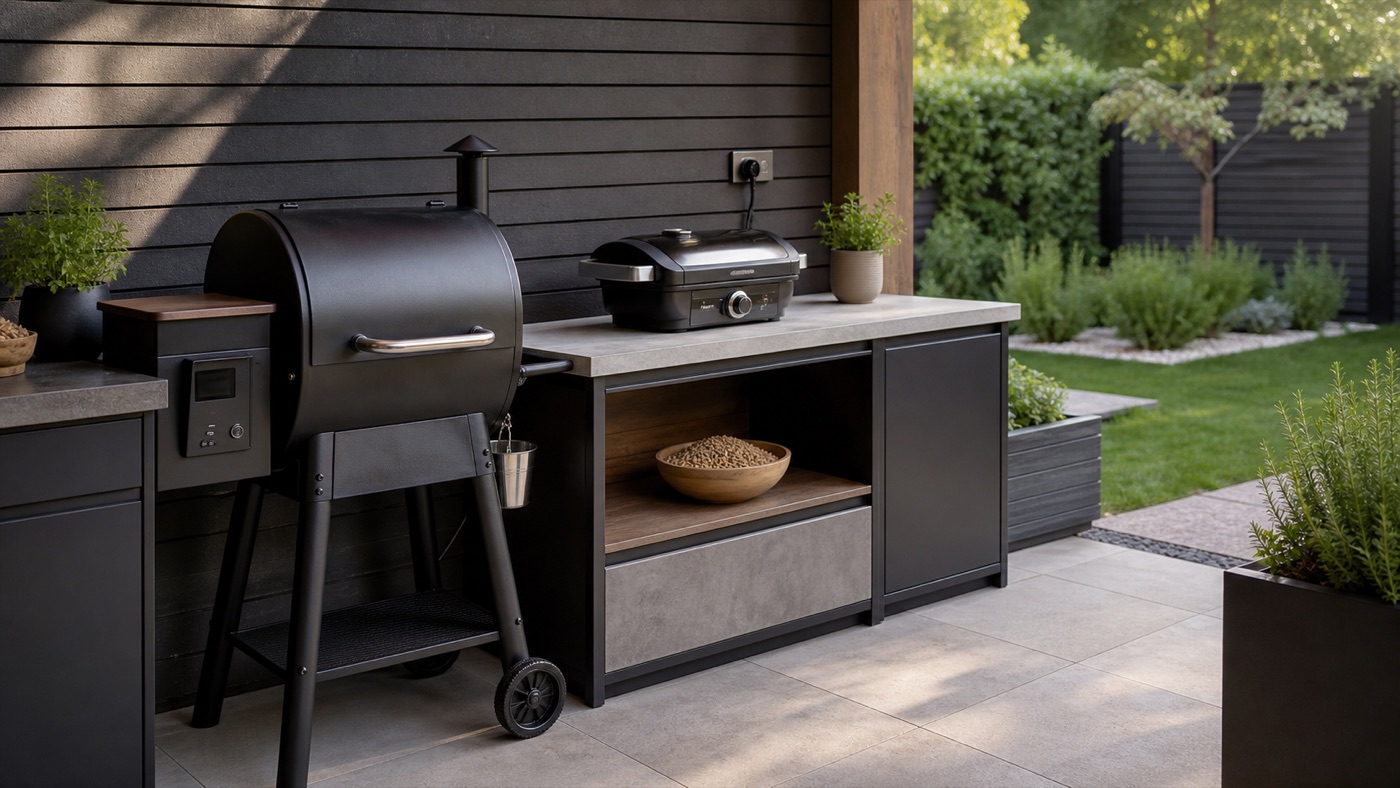
Outdoor kitchen BBQ guide
Pellet BBQs for Outdoor Kitchens
Pellet grills bring wood-smoked flavour and digital temperature control to an outdoor kitchen, but they need more planning than gas: power, dry pellet storage, smoke clearance and easy cleaning access all matter.
A pellet BBQ is best treated as the smoker and roasting station in an outdoor kitchen. It can cook ribs, brisket, pork shoulder, chicken and roasts with less fire management than charcoal, but it is not always the fastest everyday grill.
Best for
Low-and-slow cookingSmoking, roasting and steady-temperature cooks where wood flavour matters more than speed.
Watch out for
Power and damp pelletsThe controller, auger, ignition and fan need outdoor-safe electricity, and pellets must stay dry.
Best layout
Beside a gas grillUse pellet for smoke and roasting, then gas for fast weekday grilling and high-heat searing.
Visual guide
Plan a pellet BBQ as a smoker station
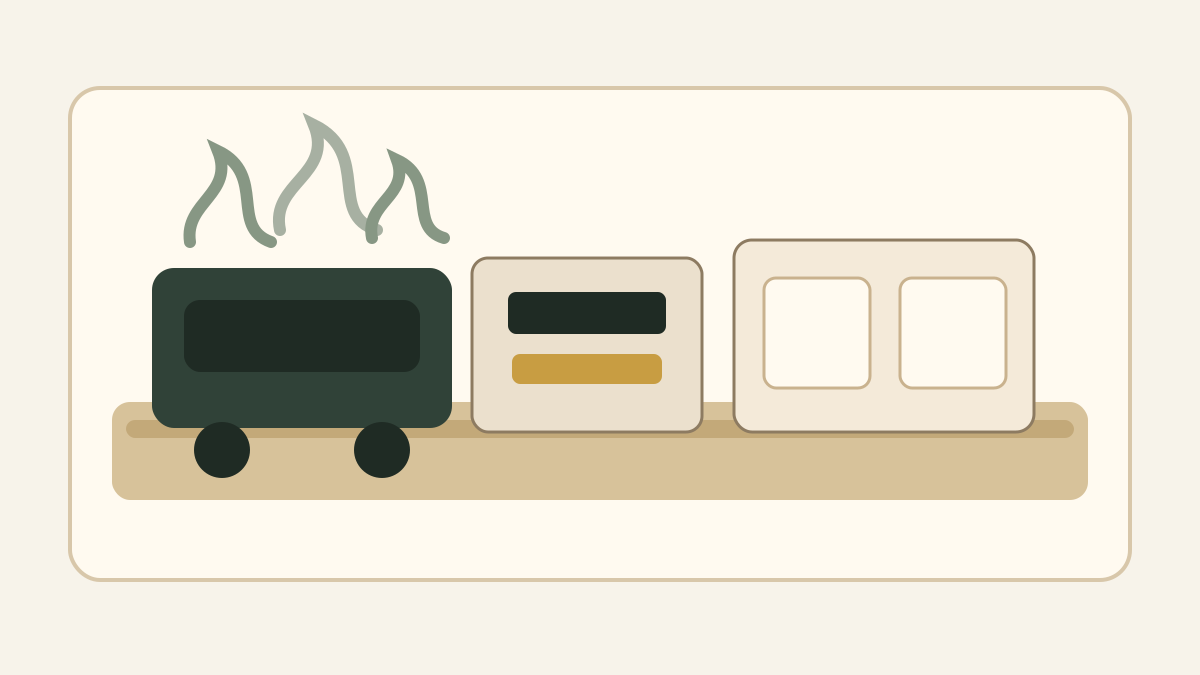
The common mistake is treating a pellet BBQ like a simple freestanding grill. In a permanent outdoor kitchen, the practical checks are where the power goes, where smoke will clear, where pellets stay dry and whether you can clean out ash and grease without dismantling the area around it.

On this page: Verdict Pros and cons Brands Buying checks Layout notes FAQs
Quick verdict
Choose pellet if you want easier smoking, not the simplest grill
Pellet BBQs are excellent when you want controlled wood smoke without managing a charcoal fire all afternoon. They make long cooks more predictable and suit outdoor kitchens where ribs, brisket, pork shoulder, smoked chicken and roasts are regular dishes.
They are less convincing as the only cooker if you mostly want quick burgers, steaks and weeknight grilling. For most permanent setups, the strongest layout is a pellet BBQ for smoking beside a gas BBQ for fast, high-heat everyday cooking.
Tradeoffs
Pellet BBQ pros and cons
Pros
- Holds steady temperatures for longer cooks.
- Adds wood-smoke flavour without tending charcoal.
- Great for ribs, pork shoulder, brisket, chicken and roasts.
- Many models include probes, Wi-Fi control and digital controllers.
- Works well as the specialist smoker beside gas or charcoal.
Cons
- Needs outdoor-safe electricity for the controller, fan, ignition and auger.
- Pellets must stay dry or they can swell, crumble and jam the feed system.
- Hard searing depends on the grill design, not just the brand name.
- More moving parts than charcoal or gas.
- Ash, grease and fire-pot cleaning still need proper access.
Brand shortlist
Popular pellet BBQ brands to compare
Pellet BBQ choice is more concentrated than gas or charcoal. Start with the brands below, then compare exact model specs rather than assuming the badge tells the whole story.

Traeger
Category leader

Pit Boss
Value and features

Camp Chef
Control and accessories

Weber
Familiar dealer network
Louisiana Grills
Specialist retail

Green Mountain Grills
Wi-Fi and portable options

recteq
US enthusiast choice

Yoder Smokers
Heavy-duty premium

Z Grills
Budget alternative
| Brand | Why compare it | Outdoor kitchen check |
|---|---|---|
| Traeger | Broad model range, strong category recognition and app-connected features. | Compare hopper size, controller features and parts support. |
| Pit Boss | Often strong on cooking area and features for the money. | Check grease management, warranty and exact UK availability. |
| Camp Chef | Good option for cooks who want control, accessories and versatility. | Look at cleaning access, side accessories and controller performance. |
| Weber SmokeFire | Familiar BBQ brand with an established support and accessory ecosystem. | Check current model reviews for heat range, grease handling and software improvements. |
| Louisiana Grills and GMG | Worth comparing through specialist BBQ retailers and compact or Wi-Fi-led models. | Confirm dealer support, spares and whether the model fits the planned space. |
| recteq, Yoder and Z Grills | Useful for US enthusiast, premium heavy-duty or budget-led research. | Check UK availability, voltage, shipping, warranty and replacement parts before building around one. |
Buying checks
What to check before buying
Controller qualityTemperature stability depends on the controller, feed system and how well the grill recovers heat after opening the lid.
Hopper sizeSmall hoppers can need refilling during long cooks; also check whether pellets can be emptied between uses.
Searing setupIf steaks are a priority, look for a direct-flame, high-heat or dedicated sear option. Do not assume every pellet grill sears well.
Cleaning accessFire-pot, ash and grease-tray access should be simple enough that maintenance does not become the reason you stop using it.
Weather and parts supportElectronics, pellets and probes need protection from damp conditions, and replacement parts should be easy to source.
Layout notes
Plan power, smoke and storage early
A pellet grill needs more planning than a kettle BBQ. Think about power, smoke exhaust, dry storage, grease management and maintenance access before fixing the final layout.
Exhaust
Keep smoke moving
Do not trap exhaust under low roofs, against walls or beside seating. Leave enough room for the lid to open and smoke to clear.
Power
Use proper outdoor electrics
Plan an outdoor-rated socket and cable route before setting the grill position. Pellet grills still need electricity even though they cook with wood pellets.
Storage
Keep pellets dry
Use a sealed box or cabinet so pellets do not absorb moisture, crumble or jam the auger.
FAQs
Pellet BBQ FAQs
Are pellet BBQs good for outdoor kitchens?
Yes, especially as a smoking and roasting appliance. They are less ideal as the only grill if you mostly want quick high-heat cooking, so many outdoor kitchens pair a pellet grill with gas or charcoal.
Which pellet BBQ brands are most popular?
Traeger, Pit Boss, Camp Chef, Weber, Louisiana Grills and Green Mountain Grills are the mainstream names to compare first. recteq, Z Grills and Yoder Smokers are also worth researching depending on budget, availability and how enthusiast-focused the setup is.
Do pellet BBQs need electricity?
Yes. Pellet grills use electricity for the controller, ignition, fan and auger. Plan an outdoor-rated socket and a safe cable route before deciding where the grill will sit.
Can a pellet BBQ replace a gas grill?
Sometimes, but not always. Pellet grills are excellent for controlled smoke, roasting and long cooks. Gas is usually quicker and more convenient for everyday high-heat grilling and weeknight cooking.
Do pellet BBQs taste like charcoal?
They produce wood-smoked flavour, but it is different from charcoal. Pellet smoke is usually cleaner, steadier and more controlled, while charcoal gives a stronger live-fire character.